Rummy Kaise Khele? 13 Card Rummy Rules in Hindi & English
Rummy kaise khele, pure sequence kya hoti hai, joker kab use hota hai, valid declaration kaise check karein aur points kaise count hote hain—ye detailed guide 13-card Indian Rummy ke common rules ko Hindi, Hinglish aur English me simple examples ke saath explain karti hai.
What Is 13 Card Rummy?
13-card Rummy ek draw-and-discard card game format hai jahan goal apne cards ko valid sequences aur sets me organize karna hota hai. “Rummy rules in Hindi”, “rummy kaise khele”, “13 card rummy rules”, “rummy sequence rules” aur “joker rules” jaise searches asal me isi basic hand-building process ko samajhne ke different tareeqe hain.
Game ke start me player ko 13 cards diye jaate hain. Ek draw pile/closed deck aur ek visible discard/open pile hota hai. Har turn me player normally ek card draw karta hai aur phir ek card discard karta hai. Is process ka purpose random cards collect karna nahi, balki hand ko logically group karna hai—pehle pure sequence secure karna, phir remaining cards ko second sequence aur sets/other valid groups me arrange karna.
“Yono Rummy” wording is site par user-search context ko refer karti hai. Kisi app ke naam me “Yono” ya “Rummy” aane se common ownership, developer identity ya official relationship automatically prove nahi hota. Exact rules bhi app aur selected game format ke hisaab se vary kar sakte hain.
🇮🇳 Rummy Kaise Khele — Step by Step Hindi / Hinglish
Step 1: 13 cards ko sort karo
Cards milte hi unhe suit ke hisaab se arrange karo—♠ Spades, ♥ Hearts, ♦ Diamonds aur ♣ Clubs. Sorting se consecutive cards jaldi nazar aate hain aur aap pure sequence ke chances identify kar sakte ho. Online interfaces me “Sort” button ho sakta hai; physical cards me manually grouping karni hoti hai.
Step 2: Sabse pehle pure sequence dekho
Beginner ke liye best starting point hai pure sequence. Same suit ke kam se kam 3 consecutive cards, bina joker substitution ke. Example:
✓ Ye valid pure sequence ka simple example hai.
Pure sequence pehle banana practical hai kyunki common 13-card rules me uske bina declaration valid nahi hoti. Agar aap baaki hand perfect bana bhi lo lekin required pure sequence missing ho, declaration fail ho sakti hai.
Step 3: Second sequence banao
Common rule structure me at least do sequences chahiye. Second sequence pure bhi ho sakti hai ya eligible joker ke saath impure sequence, depending on table rules. Example impure sequence:
Yahan joker missing 10♠ ko represent kar sakta hai, agar selected table ke joker rules ise allow karte hain.
Step 4: Remaining cards ko sets ya sequences me group karo
Sequence same suit me consecutive ranks ka group hota hai. Set same rank ke cards ko group karta hai, commonly different suits ke saath. Example set:
✓ Same rank, different suits: common valid-set structure.
Step 5: Har turn me draw + discard
Apni turn par usually aap closed pile se ek unknown card ya open/discard pile ka top visible card choose karte ho. Draw ke baad temporary 14 cards ho jaate hain; phir ek card discard karke hand wapas 13 cards ki hoti hai. Har draw se pehle socho: “Ye card meri pure sequence, second sequence ya set ko improve karega?”
Step 6: Joker ko support card samjho
Joker useful hai, lekin beginner mistake ye hai ki joker milte hi use kisi bhi group me fit kar diya jaye. Pehle pure sequence ko protect karo. Joker ko commonly impure sequence ya set ki missing position fill karne me use kiya jata hai. Required pure sequence me substitute joker use nahi hota.
Step 7: Declare se pehle full hand check karo
Declare button tab hi use karo jab har card valid group me ho aur table ki sequence requirement satisfy ho. Quick check: pure sequence hai? second sequence hai? koi duplicate-suit set problem to nahi? joker correct jagah hai? koi ungrouped card to nahi? Wrong declaration common formats me heavy penalty de sakti hai.
🇬🇧 How to Play Rummy — Step by Step in English
EnglishThe basic 13-card Rummy loop is simple: sort your hand, identify a pure sequence, build another sequence, use sets to organise remaining cards, draw one card on your turn, discard one card, and declare only after validating every group.
- Sort the 13 cards. Group by suit and rank so natural runs become easy to spot.
- Prioritise a pure sequence. In common 13-card rules, at least one joker-free same-suit sequence is required.
- Build a second sequence. Depending on the rules, this can usually be pure or impure.
- Form valid sets. A common set contains three or four cards of the same rank from different suits.
- Draw, then discard. Improve the hand one card at a time rather than collecting disconnected high-value cards.
- Use jokers carefully. They commonly substitute missing cards in impure sequences or eligible sets.
- Validate before declaring. Check every card and every group against the specific table rules.
Pure Sequence vs Impure Sequence in Rummy
“Rummy pure sequence” is one of the most important beginner concepts. Sequence ka basic meaning hai same suit ke consecutive cards. Difference joker use ka hota hai.
Pure Sequence
Three or more consecutive cards of the same suit, with no joker substituting a missing card.
✓ Same suit + consecutive + no substitute joker.
Impure Sequence
A same-suit sequence completed with an eligible joker as a substitute.
✓ Joker can represent the missing 6♣ under common rules.
Invalid Sequence Example
✕ Ranks consecutive hain, lekin suits same nahi hain.
Ace sequence rule
Many Rummy rules allow Ace in low sequence such as A-2-3 and high sequence such as Q-K-A. Ace ko middle me “wrap” karke K-A-2 jaisa sequence generally valid nahi maana jata. Because platform variations exist, selected table ka displayed rule final check hona chahiye.
Rummy Set Rules — Set Kya Hota Hai?
Set aur sequence ko confuse karna beginner error hai. Sequence same suit + consecutive rank hota hai; set same rank + different suits ka group hota hai. Example: 8♠ 8♥ 8♦. Four-card set me fourth suit bhi add ho sakta hai. Duplicate same-suit copies ke treatment me multi-deck/platform rules vary kar sakte hain, isliye table-specific validation important hai.
Joker eligible set complete karne ke liye use ho sakta hai. Lekin har joker use automatically valid nahi hota—overall declaration structure, sequence requirement aur table rules sab satisfy hone chahiye.
Rummy Joker Rules — Printed Joker aur Wild Joker
13-card Rummy me commonly do joker concepts milte hain: Printed Joker aur ek Wild Joker rank jo round ke start me select/indicate ki ja sakti hai. Inka main role incomplete groups ko complete karna hota hai.
- Joker ko impure sequence me missing card ke substitute ke roop me use kiya ja sakta hai.
- Joker eligible set ko complete kar sakta hai.
- Required pure sequence me joker substitution use nahi hota.
- Wild-joker rank ka natural card apni original identity me sequence me kaise treat hoga, ye exact platform rule se verify karein.
- Joker points commonly zero hote hain in many scoring systems, but final table rules check karna zaroori hai.
Beginner tip: Joker ko immediately “spend” mat karo. Pehle dekho kaunsa group naturally complete ho sakta hai aur kaunsi missing card position joker ke bina difficult hai.
Rummy Declaration Rules — Valid Declaration Kaise Check Karein?
Declaration tab hoti hai jab aap claim karte ho ki full hand valid groups me arrange hai. Common 13-card structure me declaration se pehle yeh checklist useful hai:
- 13 cards ka complete grouping check hua
- At least one pure sequence present hai
- At least two total sequences present hain
- Remaining groups valid sequences/sets hain
- Joker allowed role me use hua hai
- No obvious ungrouped card remains
Wrong declaration se bachna important hai. Kuch common points formats me invalid declaration maximum/full-count penalty tak le ja sakti hai. Isliye speed se zyada final validation important hai.
Rummy Points Table — Card Values, First Drop, Middle Drop
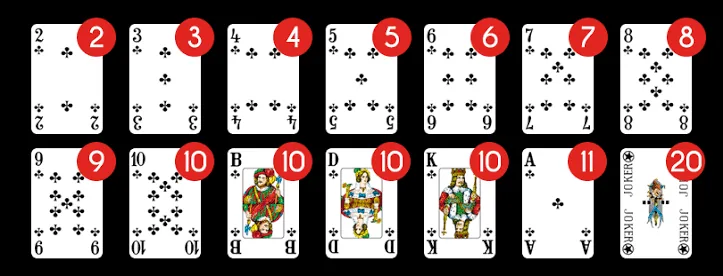
Scoring format ke hisaab se change hoti hai, so kisi ek points table ko universal rule nahi samajhna chahiye. However, many common Points Rummy rules me following pattern milta hai:
| Situation / Card | Common scoring pattern | Important note |
|---|---|---|
| Winner / valid first declaration | 0 points | Format rules apply |
| A, K, Q, J | 10 points each | Common scoring convention |
| Number cards | Face value | Example: 7 = 7 points |
| Joker | Often 0 points | Platform rules can differ |
| First Drop | Often 20 points | Common Points Rummy convention |
| Middle Drop | Often 40 points | Common Points Rummy convention |
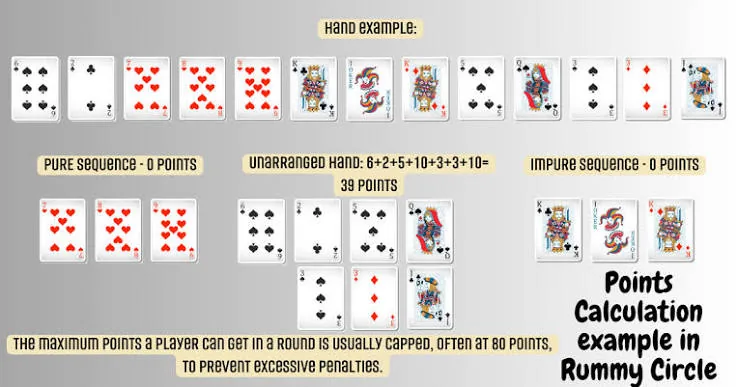
| Invalid / Wrong Declaration | Can be 80 points / max penalty | Check selected format |
Pool Rummy, Deals Rummy, Points Rummy aur platform-specific tables me drop availability ya penalty values different ho sakti hain. Example ke liye, some pool formats use different drop penalties. Isliye “first drop = 20, middle drop = 40” ko useful common reference samjhein, universal guarantee nahi.
Rummy Me Card Pick aur Discard Kaise Choose Karein?
Draw-discard decisions strategy ka core hain. Beginner level par complicated probability calculation ki zaroorat nahi. Simple approach:
- Pure sequence ko disturb mat karo. Already-made pure run ko todne se pehle strong reason chahiye.
- Connected cards ko value do. 5♥-6♥ ka pair isolated K♣ se zyada useful ho sakta hai because 4♥ or 7♥ sequence complete kar sakta hai.
- High unconnected cards ko monitor karo. Face cards points exposure increase kar sakte hain if they remain unmatched.
- Open pile information deta hai. Opponents kya pick/discard kar rahe hain, usse unki possible needs ka signal mil sakta hai.
- One-card hope me hand clutter mat karo. Multiple disconnected combinations ko simultaneously chase karna hand ko difficult bana sakta hai.
Common Rummy Mistakes Beginners Karte Hain
1. Pure sequence ke bina declaration
Sabse common structural mistake. Hand visually grouped lag sakta hai but required pure sequence missing ho to declaration invalid ho sakti hai.
2. Mixed suits ko sequence samajhna
4♥ 5♦ 6♥ ranks consecutive hain, lekin same suit nahi. Ye sequence nahi hai.
3. Joker ko pure sequence me substitute karna
Pure sequence ki defining condition hi natural consecutive same-suit cards hoti hai.
4. Same-suit duplicate ko set samajhna
Common set rules same rank with different suits expect karte hain. Multi-deck edge cases table rules se check karein.
5. Declare button jaldi press karna
Final check ke bina declaration se avoidable penalty ho sakti hai. One last scan usually worth it hai.
6. App-specific rules ignore karna
Every Rummy app/format identical scoring, drop or joker rule follow kare, ye assume nahi karna chahiye. Table rules are the final source for that round.
Rummy Rules Hindi Me — Easy Summary
अगर आप पहली बार रम्मी सीख रहे हैं, तो सबसे पहले अपने 13 पत्तों को सूट के हिसाब से लगाइए। फिर बिना जोकर वाली एक प्योर सीक्वेंस पहचानने की कोशिश कीजिए। उसके बाद दूसरी सीक्वेंस बनाइए और बचे हुए पत्तों को सेट या दूसरी वैध सीक्वेंस में लगाइए। अपनी बारी में एक पत्ता उठाइए और एक पत्ता छोड़िए। डिक्लेयर करने से पहले पूरे हाथ को दोबारा चेक कीजिए।
प्योर सीक्वेंस का आसान मतलब है—एक ही सूट के लगातार तीन या ज्यादा प्राकृतिक पत्ते, जिनमें किसी मिसिंग पत्ते की जगह जोकर नहीं लगाया गया हो। इम्प्योर सीक्वेंस में जोकर किसी मिसिंग कार्ड की जगह इस्तेमाल हो सकता है। सेट में आम तौर पर एक ही रैंक के अलग-अलग सूट वाले तीन या चार पत्ते होते हैं।
पॉइंट्स और ड्रॉप नियम अलग-अलग गेम फॉर्मेट या प्लेटफॉर्म पर बदल सकते हैं। इसलिए किसी वेबसाइट के सामान्य गाइड से ज्यादा जरूरी है कि जिस टेबल पर आप खेल रहे हैं, उसके नियम पहले पढ़ें।
Rummy Beginner Checklist — Declare Karne Se Pehle
Pure sequence? ✓ Second sequence? ✓ Remaining sets/sequences valid? ✓ Joker placement valid? ✓ No loose card? ✓ Table-specific rules checked? ✓
Agar inme se kisi point par doubt hai, declare karne se pehle hand ko dubara arrange karo. Visual grouping mistakes especially mobile screen par easily ho sakti hain.
13 Card Rummy Terms — Quick Glossary
| Term | Simple meaning |
|---|---|
| Sequence | Same suit ke consecutive cards ka group |
| Pure Sequence | Sequence without joker substitution |
| Impure Sequence | Sequence completed with an eligible joker |
| Set | Same rank ke commonly different-suit cards ka group |
| Printed Joker | Deck ka printed joker card |
| Wild Joker | Round ke liye selected/indicated joker rank |
| Draw | Turn me card pick karna |
| Discard | Turn end par card open pile me dena |
| Declaration | Claim that the full hand is validly grouped |
| Drop | Round ko complete kiye bina exit karna, where allowed |
Rummy FAQ — Frequently Asked Questions
Rummy me kitne cards hote hain?
Common Indian Rummy format me har player ko 13 cards milte hain. Deck count/player setup vary kar sakta hai, so exact table rules check karein.
Rummy me pure sequence kya hoti hai?
Same suit ke teen ya zyada consecutive natural cards ka group, jahan joker kisi missing card ko substitute nahi karta. Common 13-card rules me at least one pure sequence normally required hoti hai.
Rummy me kitni sequence chahiye?
Common 13-card structure me usually at least two sequences chahiye, aur unme se at least one pure sequence hoti hai. Platform/table rules final authority hain.
Rummy me joker kaise use karein?
Printed ya selected wild joker ko commonly impure sequence ya eligible set complete karne ke liye use kiya jata hai. Required pure sequence me substitution joker use nahi hota.
First drop aur middle drop kitne points hote hain?
Many Points Rummy rule sets me first drop 20 aur middle drop 40 points hota hai. Pool/Deals/platform formats differ kar sakte hain. Actual table ke displayed rules follow karein.
Wrong declaration kya hoti hai?
Jab declared hand required sequence/set structure satisfy nahi karta, use invalid/wrong declaration kaha jata hai. Many common formats me penalty high ho sakti hai, sometimes maximum/full-count level tak.
Kya Joker pure sequence me use ho sakta hai?
Missing card ko replace karne ke liye nahi. Some rules wild-joker rank ke natural card ko uski original suit/rank position me treat kar sakte hain; exact table rule check karein.
Kya ye page real-money Rummy recommend karta hai?
Nahi. Ye educational rules guide hai. India me current national online-gaming law online-money games aur unki promotion/facilitation par restrictions lagata hai. Current law aur platform classification independently verify karein.
Related Rummy & Yono Help
Browse the documented All Yono Rummy Apps list or return to the All Yono Games directory for app-name discovery and status links.
“Trending game” label bina reliable trend evidence ke use karna misleading ho sakta hai. Isliye yahan neutral, useful internal links diye gaye hain jo Rummy rules samajhne ke baad commonly relevant ho sakte hain.
Responsible Use & Safety
Card-game rules samajhna aur online-money gaming participate karna do alag cheezein hain. If an app asks for money, deposits, financial details, permissions, identity documents or payment credentials, pause and verify the service, current legal status, privacy practices and grievance options. OTP, password, UPI PIN, card PIN ya sensitive banking credentials kabhi share na karein.
For current Indian legal context, refer to the Government of India’s and the .
Editorial note: This guide describes common 13-card Indian Rummy mechanics found across multiple rule references. Exact deck setup, joker handling, drop availability, points and declaration validation can vary by format/platform. Last reviewed: 10 September 2026.